The Ivy Lee Method: A 100-Year-Old System That Still Outperforms Modern Productivity Apps
 Jax JacksonBy William "Jax" Jackson
The Problem Is Not That You Don't Know What to Do
I have watched a lot of people go through career transition, veterans, reservists, federal employees, people who spent twenty years being exceptionally good at their jobs, and the pattern that shows up most consistently is not a lack of skill or a lack of effort. It is a lack of prioritization discipline.
They are busy. Genuinely busy. Updating the resume for the fourth time. Attending every virtual career fair on the calendar. Scrolling job boards for two hours. Responding to every LinkedIn message the moment it arrives. At the end of the day, they have done a lot of things and moved almost nothing forward.
I know this pattern because I lived it. When I transitioned out of active duty Navy after 13 years, I had no shortage of activity. What I lacked was the discipline to separate what was important from what was merely urgent or comfortable. Most people in transition never learn to make that distinction deliberately, and it costs them months.
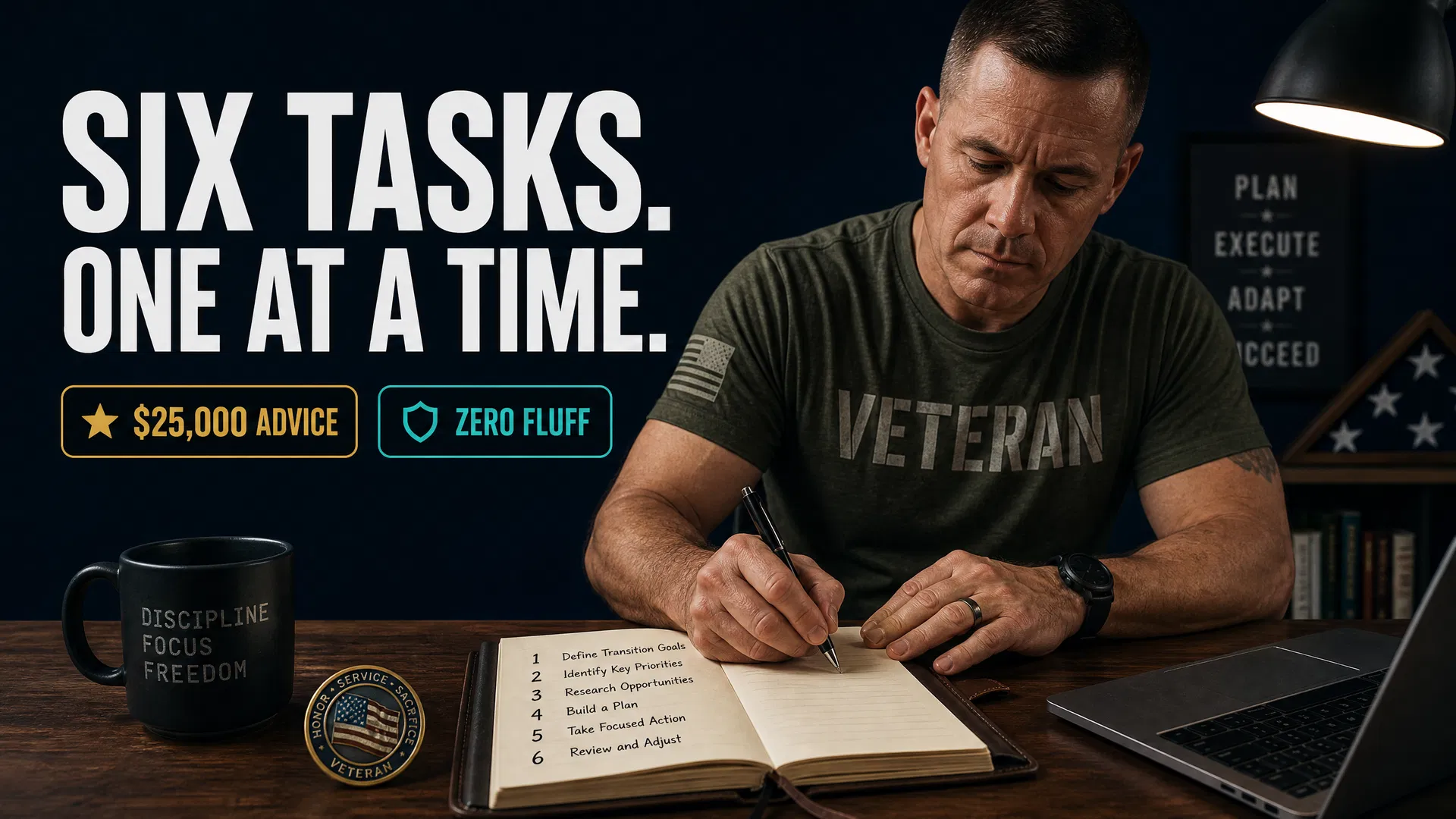
A consultant named Ivy Lee figured this out in 1918. He walked into Bethlehem Steel Corporation, gave Schwab's executive team a system so simple it sounds like it shouldn't work, and three months later Schwab paid him $25,000, over half a million dollars today, because it did.
The system: at the end of each day, write down the six most important things you need to accomplish tomorrow. Rank them by priority. Start with number one the next morning and do not move to number two until it is finished. Move whatever didn't get done to the next list. Repeat.
Why Simple Outperforms Complex
When I was managing teams at Walmart and Sam's Club after leaving active duty, the people who consistently outperformed weren't the most talented. They were the ones who showed up with clarity about what they were doing that day and why. The people who struggled let the day's urgency dictate their priorities instead of deciding their priorities before the day started.
The military trains you to respond to the most urgent thing in the environment. In a career transition, that instinct will quietly sabotage you. The civilian world manufactures urgency constantly, notifications, messages, requests, meetings, and none of it is organized around what actually matters for your career.
The Ivy Lee Method forces you to make the prioritization decision the night before, when you have perspective and time to think clearly, rather than in the morning when the environment is already pulling at you. You decide in advance. Then you execute.
The six-task constraint forces you to choose. A list of six tasks requires you to accept that some things will not get done today. That acceptance is not failure, it is strategic clarity. The person who finishes six high-priority tasks every day for ninety days will outperform the person who attempts thirty and finishes twelve, every single time.
What This Looks Like in a Real Transition
When I was doing defense sector recruiting and later at Amazon AWS, I worked with a lot of transitioning veterans. The ones who struggled most were not the ones with the weakest backgrounds. They were the ones who could not tell me, on any given day, what the three or four most important things were that they needed to do to move their search forward.
They had lists. Long lists. But the lists were not ranked and they were not honest. The most important tasks, the networking conversation they had been avoiding, the LinkedIn profile section they kept putting off, the informational interview they needed to schedule, were always at the bottom, buried under things that felt productive but weren't.
The Ivy Lee Method, applied to career transition, is one question asked every evening: if I could only accomplish six things tomorrow, what would they be? Not the most comfortable six. The six that would actually move the transition forward. Rank them honestly, if you could only finish one, which one would it be, and commit to working through them in that order the next morning.
The morning execution requires one discipline that does not come naturally to people trained in the military: you do not check email, you do not open LinkedIn, you do not respond to messages until task one is finished. The military trained you to respond to the most urgent thing in your environment. Career transition requires you to protect the important from the urgent.
The Zero Fluff Connection
The Zero Fluff framework, Lock On, Execute, Win, maps directly onto the Ivy Lee structure. Lock On is the evening planning session. You identify the target before the day starts, not while you are already in motion. Execute is the morning discipline, one task at a time, in order. Win is the daily review, where you assess honestly what you accomplished, learn from what you did not, and set up tomorrow's mission.
The Daily 3-1-0 tool on this site runs on the same principle: three priorities, one learning objective, zero obstacles. If you have been using it, you already understand the core discipline. The Ivy Lee Method is the full version, extended to six tasks and formalized into a daily ritual that compounds over time.
The transition is not won in a single day of intense effort. It is won through consistent, disciplined execution of the right priorities, day after day, until the compounding effect of that clarity produces results that look like luck from the outside.
The Drill
At the end of today, take fifteen minutes and write down the six most important things you need to do tomorrow to move your career transition forward. Be honest about what actually matters. Rank them from most important to least. Tomorrow morning, start with number one and do not move to number two until it is finished.
Do that for thirty days and then tell me what changed.
Connect with Jax Jackson
For more frameworks on productivity, career transition, and personal branding, connect with me on LinkedIn, subscribe to my Jax Nexus Substack, or follow The Nexus Chronicles newsletter for practical Zero Fluff strategies on building a career transition that actually works.
Ready to put this into practice today? Start with the Daily 3-1-0 tool at Jax Nexus, a structured daily planning framework built specifically for service members and veterans navigating career transition. It takes less than five minutes and gives you the clarity to execute with purpose every single day.
Lock on. Execute. Win.
, Jax
The views expressed in this article are those of the author based on personal experience and do not reflect the official policy or position of the Department of Defense, the Office of Personnel Management, or the U.S. Government.
Found this useful? Share it with someone who needs it.
Share on LinkedInNever Miss an Insight
Subscribe to get biweekly talent branding strategies and career transition tips.
Free insights. No spam. Unsubscribe anytime.
Subscribe to The Passdown
Biweekly federal hiring intel, one execution drill, and what's actually working for veterans getting federal offers right now.
Subscribe Free →Your next mission: Know your federal career value.
Calculate your GS grade and salary range based on your MOS, clearance, and experience. Takes 3 minutes. Chapter 10 included.
Calculate NowDisclaimer: The views expressed are the author's personal experience and do not reflect the official policy of the Department of Defense, Office of Personnel Management, or U.S. Government.
Continue the field work
Related Posts
Keep building your transition strategy with the next useful read.
Remember Lot's Wife: The Cost of Looking Back
Veterans don't just carry rucks, we carry our past lives. Jesus gives us three words about that loadout: "Remember Lot's wife." Here is what that means for anyone navigating the hardest transition of their life.
You're Still in Uniform. Your Brand Clock Is Already Running.
Most active duty service members think personal branding is something you do when you're getting out. That's exactly backwards. The best time to build your brand is while you're still in uniform, here is why and how to start now.
The Reservist Brand Problem Nobody Talks About (And the Zero Fluff Fix)
You serve one weekend a month and carry more leadership experience than most civilians accumulate in a decade. But you're invisible in both worlds. The Zero Fluff methodology gives reservists a framework to build an integrated brand that gets full credit in both the civilian market and the military context.