Federal vs. Corporate Resumes: Why You Need Both (And How They Are Different)
 Jax JacksonBy William "Jax" Jackson
Federal vs. Corporate Resumes: Why You Need Both
By William "Jax" Jackson
I see this mistake all the time.
A veteran spends weeks building the perfect federal resume. Two pages. Every detail. Hours per week. Supervisor contact info. Salary history. The whole OPM-compliant package.
Then they take that same resume and send it to Amazon.
Or Microsoft.
Or a defense contractor.
And they get ghosted.
Not because the resume is bad. But because they sent a federal resume to a corporate job.
It's like showing up to a formal dinner in PT gear. Wrong uniform. Wrong mission.
The Two Tracks
If you're transitioning out of the military, you have two career tracks in front of you:
Federal Track 🏛️ - Government agencies, GS positions, USAJOBS applications.
Corporate Track 🏢 - Private sector companies, defense contractors, tech firms, healthcare systems.
Each track has its own rules. Its own format. Its own expectations.
And if you don't know the difference, you're going to waste months applying to the wrong jobs with the wrong resume.
Federal Resumes: The Detail-Obsessed Format
Federal resumes are not like anything you've seen before.
They're long. They're detailed. They're keyword-heavy. And they're designed to survive a very specific screening process.
Here's what makes a federal resume different:
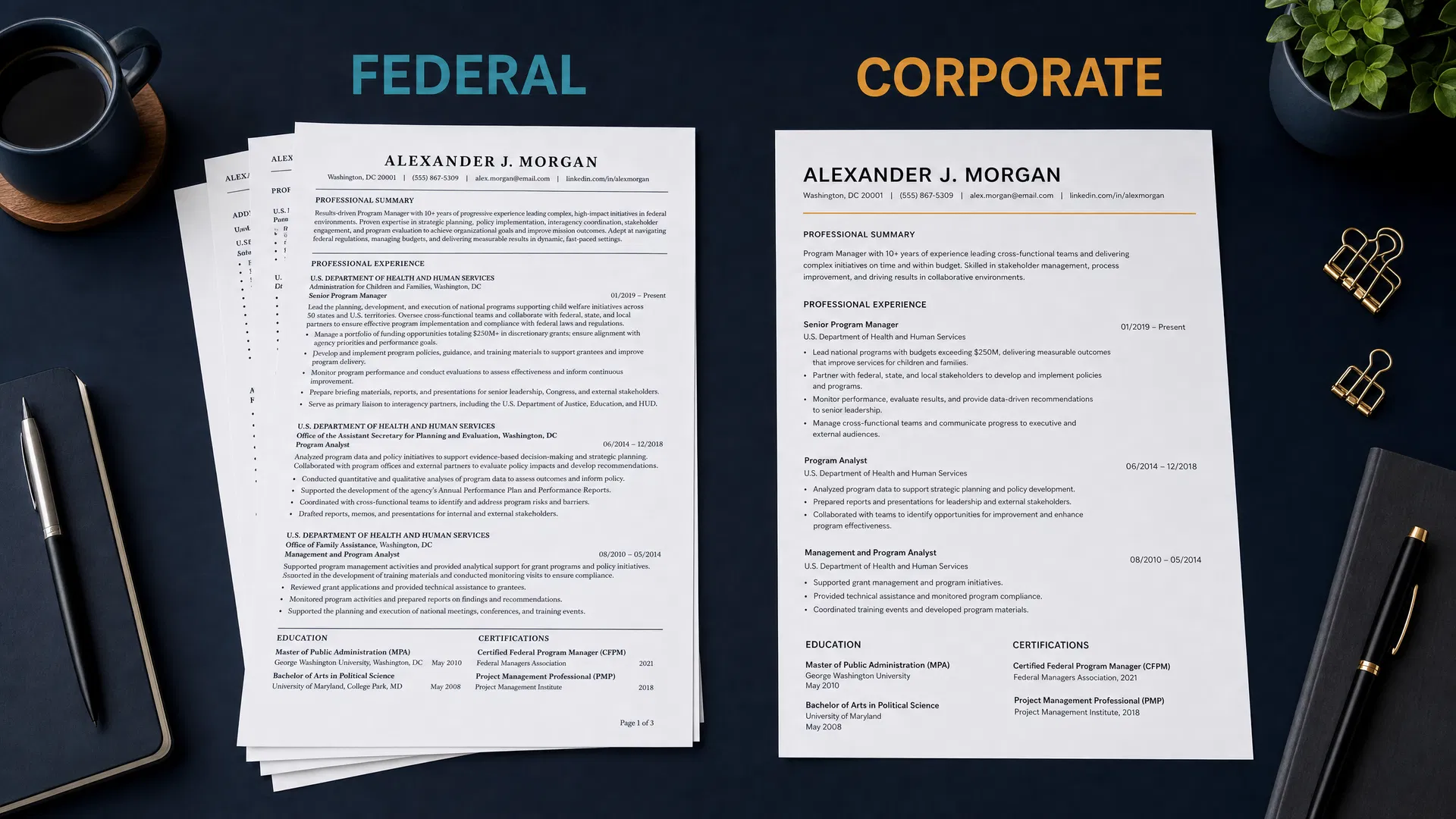
1. Length: 2+ Pages (Yes, Really)
Corporate recruiters will tell you to keep it to one page. Federal HR specialists will tell you the opposite.
They want detail. They want context. They want proof that you meet every single qualification in the job announcement.
A one-page resume in the federal world looks like you didn't take the job seriously.
2. Keywords Are Everything
Federal resumes get screened by HR specialists who are literally checking boxes.
Did you say "Strategic Planning"? Check.
Did you say "Budget Execution"? Check.
Did you say "Stakeholder Management"? Check.
If the job announcement says "Strategic Planning," you better say "Strategic Planning" - not "strategic initiatives" or "long-term planning." Mirror the exact language.
3. The OPM Format Requirements
Every federal resume must include:
- Hours per week for each job (e.g., "40 hours/week")
- Salary for each position
- Supervisor name and contact info (with permission to contact)
- Citizenship status ("U.S. Citizen")
- Security clearance (if applicable)
- Veteran's preference (5-point, 10-point, or none)
Miss any of these? Your resume gets kicked out before a human even reads it.
4. The CAR Method (Context-Action-Result)
Federal bullets need to be detailed. Not just "Led a team." But:
"Directed 30-person logistics team managing $4.2M in equipment accountability across 3 deployed locations, achieving 99.8% inventory accuracy and zero mission-critical shortages over 12-month period."
Context. Action. Result. With numbers.
5. New for 2025: The Essay Questions
As of September 2025, all GS-05+ positions require four 200-word essays submitted separately:
- Constitutional Commitment - How has your commitment to the Constitution inspired you to pursue this role?
- Government Efficiency - How would you use your skills to improve government efficiency?
- Executive Order Alignment - How do your values align with current administration priorities?
- Work Ethic - Describe your work ethic and commitment to public service.
These aren't on your resume. They're separate. But you need to prepare them in advance.
Corporate Resumes: The Impact-Focused Format
Corporate resumes are the opposite.
They're short. They're scannable. They're designed to survive a 6-second skim by a recruiter who's looking at 200 resumes that day.
Here's what makes a corporate resume different:
1. Length: 1 Page Only
No exceptions. No "but I have 20 years of experience."
One page.
If you can't fit your career on one page, you're not being strategic about what matters.
2. Impact Over Duties
Corporate recruiters don't care what you were responsible for. They care what you achieved.
Bad: "Responsible for managing team operations."
Good: "Reduced operational costs by 23% while improving team productivity by 15%."
Lead with results. Not responsibilities.
3. No Military Jargon
Corporate recruiters don't know what an E-7 is. They don't know what a platoon sergeant does. They don't care about your MOS.
Translate everything:
- "Platoon Sergeant" → "Operations Manager overseeing 40 personnel"
- "Battalion S-3" → "Strategic Planning Lead for 800-person organization"
- "Deployed to Afghanistan" → "Led operations in high-threat environment supporting 2,500 coalition forces"
Speak their language.
4. Visual Hierarchy Matters
Corporate resumes need white space. They need section breaks. They need to be scannable.
Use bold for job titles. Use bullet points. Use consistent formatting.
If a recruiter can't find your key achievements in 6 seconds, your resume goes in the "no" pile.
5. ATS-Friendly Formatting
Most corporate resumes get screened by Applicant Tracking Systems (ATS) before a human ever sees them.
That means:
- No tables or text boxes
- No headers or footers with critical info
- No fancy fonts or graphics
- Use standard section headers ("Experience," "Education," "Skills")
Keep it clean. Keep it simple.
The Samples: See the Difference
We've built resume templates for both tracks.
Federal Resume Sample: Marcus Thompson
- E-8 Air Force → GS-13 Program Analyst at VA
- 2 pages, OPM 2025 compliant
- Shows how to translate 18 years of military leadership into federal civilian language
Corporate Resume Sample: Daniel Castillo
- E-6 Space Force → Patrol Sergeant
- 1 page, impact-focused
- Shows how to condense 10 years of security operations into a tight corporate format
Military Spouse Samples: Sarah Reynolds
- 6 PCS moves in 12 years → HR Specialist
- Both federal (2-page) and corporate (1-page) versions
- Shows how to frame relocations as adaptability and highlight PPP-S hiring preference
Download all templates at JaxNexus.com/resume-templates
Which Track Should You Choose?
Here's the truth: You don't have to choose.
Build both.
If you're applying to USAJOBS, use the federal format.
If you're applying to Amazon, use the corporate format.
If you're applying to a defense contractor? It depends. Some want federal-style detail. Some want corporate-style brevity. Read the job posting and match the tone.
The Bottom Line
One resume doesn't work for both tracks.
Federal wants detail. Corporate wants impact.
Federal wants 2 pages. Corporate wants 1.
Federal wants keywords. Corporate wants results.
Build both. Use the right one for the right job.
And stop wondering why you're getting ghosted.
Ready to build your resumes?
Download the Zero Fluff Resume Templates - Federal and Corporate formats with completed samples.
No fluff. Just the format that works.
Lock on. Execute. Win.
Found this useful? Share it with someone who needs it.
Share on LinkedInNever Miss an Insight
Subscribe to get biweekly talent branding strategies and career transition tips.
Free insights. No spam. Unsubscribe anytime.
Get The Zero Protocol, Free
The framework Jax built after 25 years of military service and years on the federal hiring side. One chapter. One system. Yours free when you subscribe to The Passdown.
Get The Zero Protocol →Ready to know your federal career value?
Use the Federal Career Value Calculator to discover your GS grade range and salary potential in under 3 minutes. You'll also get Chapter 10: The Negotiation - the complete federal salary playbook.
Calculate Your Federal ValueDisclaimer: The views expressed are the author's personal experience and do not reflect the official policy of the Department of Defense, Office of Personnel Management, or U.S. Government.
Continue the field work
Related Posts
Keep building your transition strategy with the next useful read.
The 6-Second Resume Scan: What Recruiters Really See
I spend exactly six seconds on your resume during the first pass. Six seconds. Here's what I'm looking for,and why a Lieutenant Colonel's 7-page resume lost to a Major's 1-pager.
Corporate vs Federal Interviews: Two Battlefields, Two Tactics
The interview is not a conversation. It's Close Quarters Combat. Corporate hunts for culture fit. Federal hunts for keywords. Here's how to win both.
The Federal Fortress: How to Get Through the Gate
You submit a resume. You wait three months. You get an email: "You have been found ineligible." Here's what's actually happening on the other side of that wall,and how to make it easy for HR to say "Yes."